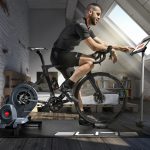
Turbo trainers have become a cyclist’s best friend when getting outside isn’t an option. These clever training tools work by simulating the rolling resistance you would normally experience on the road, indoors.
In this guide, we explain how turbo trainers work and how to set one up correctly, so you’re ready for effective and enjoyable indoor cycling sessions.
What are the different types of turbo trainer?
Before purchasing a turbo trainer, it’s useful to understand the two main types available: wheel-on turbo trainers and direct-drive turbo trainers.
Wheel-on turbo trainers
Wheel-on turbo trainers use your bike’s existing rear wheel. The back tyre sits against a roller on the trainer, which creates resistance as you pedal. This resistance comes from the friction between the tyre and the roller. Wheel-on trainers are usually more affordable and are a popular choice for riders new to indoor cycling.
Direct-drive turbo trainers
Direct drive trainers work differently. You remove the rear wheel and attach the bike frame directly to the trainer. The chain connects to a cassette mounted on the trainer, which often needs to be purchased and fitted separately. A built-in flywheel provides resistance, giving a smoother and more realistic road feel. Many cyclists find direct-drive trainers to be more accurate and quieter than wheel-on models.
The choice of which turbo trainer is right for you depends on your bike, your riding style and the size of your wallet. The good news is that both trainers will give you an excruciating workout if you’re brave enough!
What do I need to set up my turbo trainer?
You should set up your turbo in the place you want to use it because once you’ve fixed your cycle to the trainer, it’s difficult to move.
Without the wind in your face and on your body, you’re going to sweat a lot while turbo training, so consider investing in:
- Turbo trainer mat
- Large indoor fan
If pennies are tight and you want to save some money, place some towels or protective sheets on the floor. This will also stop any mud or grease from your bike getting on the floors surface.
How do I set up a wheel-on turbo trainer?
Step 1: Clear your space
Make sure you have enough room to set up your turbo trainer. Move the roller backwards to make space for your rear wheel. You should be able to do this with your hands—don’t force anything.
Step 2: Fit the rear wheel
Position the rear wheel spindle into one of the trainer’s sockets, then clamp the other side in place. The clamps aren’t pre-set, so adjust them by hand until your bike is secure. A little trial and error may be needed.
Step 3: Use the correct skewer
Most standard bike skewers won’t fit snugly in the trainer clamps. Use the skewers supplied with your turbo trainer to prevent slippage or damage. These are usually long enough for rim or disc brakes. If your rear dropouts are wider than normal, extra-long skewers are available separately.
Step 4: Adjust the roller pressure
Once the rear wheel is secured, it won’t move. Many trainers have a latch or ratchet to raise the roller to meet the tyre. Follow the manufacturer’s instructions to adjust the pressure correctly for realistic road-like resistance.
Step 5: Check tyre pressure
Tyre pressure affects resistance, pedal feel, and slippage. Keep it consistent for accurate and safe training. A typical range is 90–120 psi, but find a level that works for you. Too low makes pedalling heavy and can burn rubber; too high can cause the tyre to slip during sprints. Make a note of the correct pressure and stick to it for every session. New tyres will need this process repeated.
Step 6: Level the front wheel
Use a purpose-built front wheel riser to level your bike. Avoid DIY solutions—these protect both you and your bike from slips, falls, and damage.
How do I set up a direct-drive turbo trainer?
Step 1: Check your cassette
Before you start, and after you have cleared some space, make sure your direct-drive turbo has the same number of sprockets as your bike. A 10-speed chain won’t fit properly on an 11-speed cassette, and vice versa.
Step 2: Remove the rear wheel
Shift your chain onto the smallest cog and release the quick-release lever. Push the rear derailleur back and lift the frame to slide the rear wheel out. Take care not to catch the spokes or damage the rear dropout.
Step 3: Position the bike on the turbo
Take your bike to the turbo trainer and gently lower it into place. Pull the derailleur back and guide the chain onto the smallest cog. Fit the bike onto the quick-release skewer carefully.
Step 4: Check alignment
Ensure the bike is level on the turbo and not at an angle. Misalignment can affect chain smoothness and potentially damage your frame.
Step 5: Secure the quick-release skewer
Tighten the quick-release skewer so the bike is held firmly. A useful tip: tighten until it leaves a white mark on your hand when clipped into place. Too tight can cause damage; too loose and the bike could pop off while riding.
Step 6: Fit axle adaptors (if needed)
Most turbos come with axle adaptors to accommodate bikes with through axles. Use these as required to fit your bike correctly.
Step 7: Check front wheel setup
Some direct-drive trainers require a raised front wheel, while others do not. Before starting your ride, check the manufacturer’s instructions or website to see if you need a front wheel riser.
So, now you know how to set up a turbo trainer. The next step is to climb on and get pedalling!
For everything you need to keep your bike in perfect condition, including bike servicing and free bike checks, head over to Halfords.com or pop into your local store, where one of our experts will be happy to help.